Dove believes that every woman’s version of beauty is different and the differences are there to be celebrated (Unilever.) As part of Dove’s ongoing “Real Beauty” campaign, agency Ogilvy London created six “Real Beauty Bottles” for customers in the UK (Calfas.) The campaign was aimed to celebrate beauty diversity with their limited edition range of body washes (Unilever.) These bottles were created to to reflect the diverse bodies of women using the product (Calfas.) Dove wanted to convey that beauty comes in all shapes and sizes (Unilever.) They were designed as a reminder that beauty is diverse and diversity is beautiful (Unilever.) Just like women, Dove wanted to show that their bottle could come in all shapes and sizes too (Unilever.) According to Dove’s Global Beauty and Confidence Report, “One in two women feels social media puts pressures on them to look a certain way.” Dove truly believes they are helping women embrace their own individuality as a source of confidence (Unilever.)
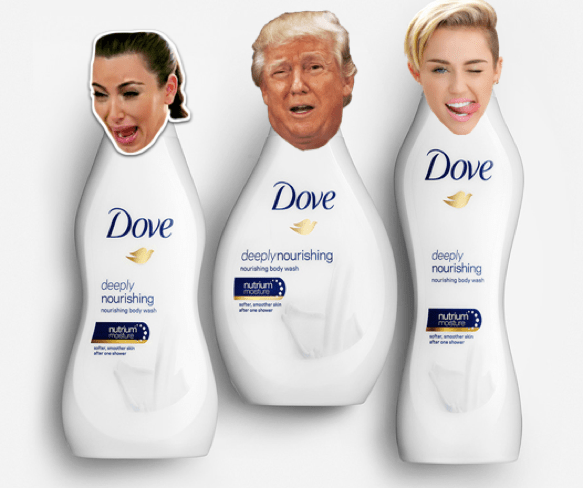
Dove’s intended message of beauty diversity and acceptance, which has historically worked very well, was interpreted very differently by consumers (Cools, 2017.) The campaign attempted to take their brand image of body positivity from a metaphorical concept to a literal one (Cools, 2017.) It was widely criticized, leaving many confused and others downright offended (Cools, 2017.) The conversation around the campaign focuses less on body positivity and more so on how odd it is that Dove would want bottles to resemble human bodies, expects consumers to want bottles that look like bodies, and the fact that they think the bottles even resemble bodies in the first place (Shamsian, 2017.) Literally comparing women’s bodies to plastic soap bottles did not go over well with the majority of consumers (Cools, 2017.) The flatness of the advertising campaign reminds people that as a beauty company, Dove fundamentally wants to be in the conversation about body positivity in order to sell more products (Shamsian, 2017.)
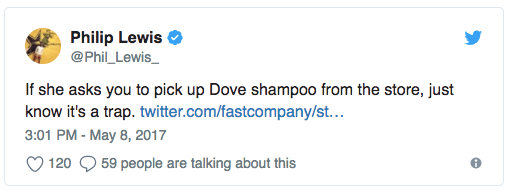
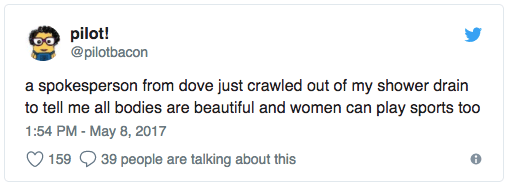
Critics said that grouping women into categories based on their bodies, was far from embracing, Dove found a way to make something as simple as buying soap about the shape of women’s bodies (Cools, 2017.) One Twitter user remarked “Finally, consumers without arms, legs, or heads can buy a soap bottle that truly represents them (Cools, 2017.)” Much of the criticism suggested that comparisons to the bottles of body wash are unflattering or ridiculous regardless of body shape (Kirkpatrick, 2017.) Dove has long put body positivity front-and-center with their 15 year running “Real Beauty” campaign. This body wash packaging represents a rare misstep for the brand (Kirkpatrick, 2017.) It is most concerning for Dove that the social media backlash doesn’t just include the typical snarky criticism, many called the brand out on a lack of authenticity and even exploiting insecurities to sell it’s product – the exact opposite of their intended goal (Kirkpatrick, 2017.)
Although the campaign was widely criticized, according to AdAge, social media failure doesn’t always translate to real failure. A survey of more than 2,200 Americans by Morning Consult found that no damage to Dove’s image occurred (AdAge, 2017.) 41% of people came away with a more favorable view of Dove after seeing images from the campaign, and only 9% had a less favorable view of the brand (AdAge, 2017.) 71% of survey respondents said they were still likely to purchase Dove products, an increase of 3 points from prior to viewing the campaign images (AdAge, 2017.)
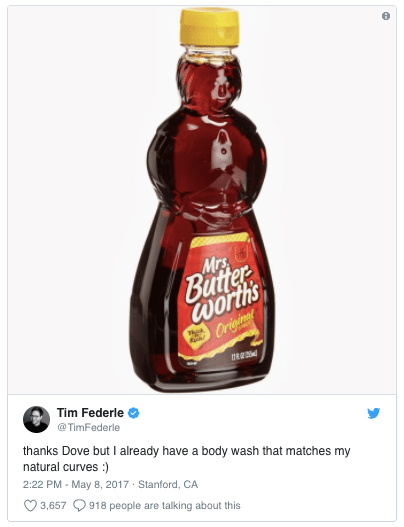
Dove has since removed the Real Beauty Bottles from shelves, but it is unclear whether this was due to the overwhelmingly negative feedback, or the end to a limited edition promotion (Cools, 2017.) Dove is still promoting them under the campaign portion of their site, and they have not responded in any official capacity (Cools, 2017.)
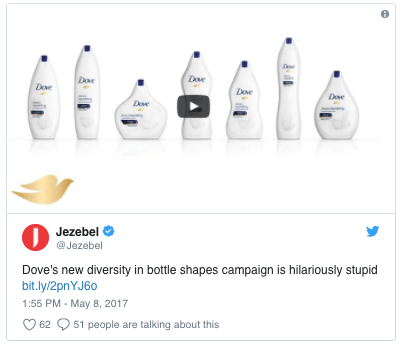
The assumption that a woman would want to purchase the bottle of soap most closely related to their body shape is both ridiculous and objectifying. The campaign comes off as insulting to a woman’s intelligence. I understand that this was Dove’s attempt to differentiate an ordinary, everyday product but this could have been improved upon by removing the physical reference to a woman’s body completely. There is never an appropriate time to objectify a woman’s body. With the #MeToo movement in the news almost daily, it is particularly concerning that this campaign did not raise any red flags before being released.
Dove could have improved upon this by making the bottles feel personalized in a more desirable way. They could have differentiated their products by emphasizing their functional benefits instead of changing the shape of the bottle. Dove could have focused in on the fact that women have different hair and skin types. This could be used to market different products that work well for dry skin, oily skin, medium skin, dry hair, etc. Making this change would give the woman the feeling that she is purchasing a product personalized for her individual needs, while not feeling that the brand is making an inappropriate reference to her body type.
Sources:
Calfas, J. (n.d.). People Are Confused About Dove’s New Body Wash Bottles. Retrieved January 31, 2018, from http://fortune.com/2017/05/08/dove-body-wash-bottles/
Shamsian, J. (2017, May 08). Dove’s new body wash bottles are designed to match different body types – and the internet can’t stop making fun of it. Retrieved February 13, 2018, from http://www.businessinsider.com/dove-body-wash-bottles-match-body-types-2017-5
Image URLs:


 Stephanie Milak
You must be logged in to post a comment.